A perfect circle of mushrooms on a lawn, so neat it looks drawn with a compass, has been asking the same question for centuries: who made that, and why? Long before anyone had the word mycelium, people had an answer. It usually involved something wearing a cloak.
The ring belonged to somebody else
European folklore is oddly consistent on this point. In England the rings belonged to fairies. In Cornwall they were the work of piskies; in Wales, of the Tylwyth Teg, whose circles were called cylch y Tylwyth Teg. Scotland and Ireland had their own versions. Across the Channel the same shape was blamed on witches — ronds de sorcières in France, Hexenringe in Germany.
The logic was sound enough for the evidence available. The mushrooms turned up overnight after rain, arranged in a circle, with grass inside that looked wrong: either scorched and bald or greener than anything around it. No human had done that. So something else had, and that something had opinions.
What you were supposed to do about it
Rules varied from parish to parish, but they clustered around one idea: stay out of the ring and leave it be.
- Don't step inside. The most common warning was that anyone entering would be compelled to dance, sometimes until they dropped, sometimes for what felt like one night and turned out to be seven years.
- Don't eat the mushrooms. They were fairy food. Eating them was said to leave you in the fairies' debt, or unable to find your way home.
- Don't disturb the ground. Farmers left arcs unploughed. Fences were moved. Someone who damaged a ring risked bad luck falling on the cattle, the milk or the household.
- Don't build on one. In various accounts rings were doorways, and a house raised over one was never quiet again.
- Watch the children. The stories that lasted longest were the ones about children who wandered in and came back changed, or did not come back at all.
Not every tale was a threat. Some promised luck to households that left a ring alone, and a few traditions considered the grazing inside a ring unusually sweet. Either way, the practical advice pointed the same direction: admire, don't interfere.
The mushroom is only the visible part
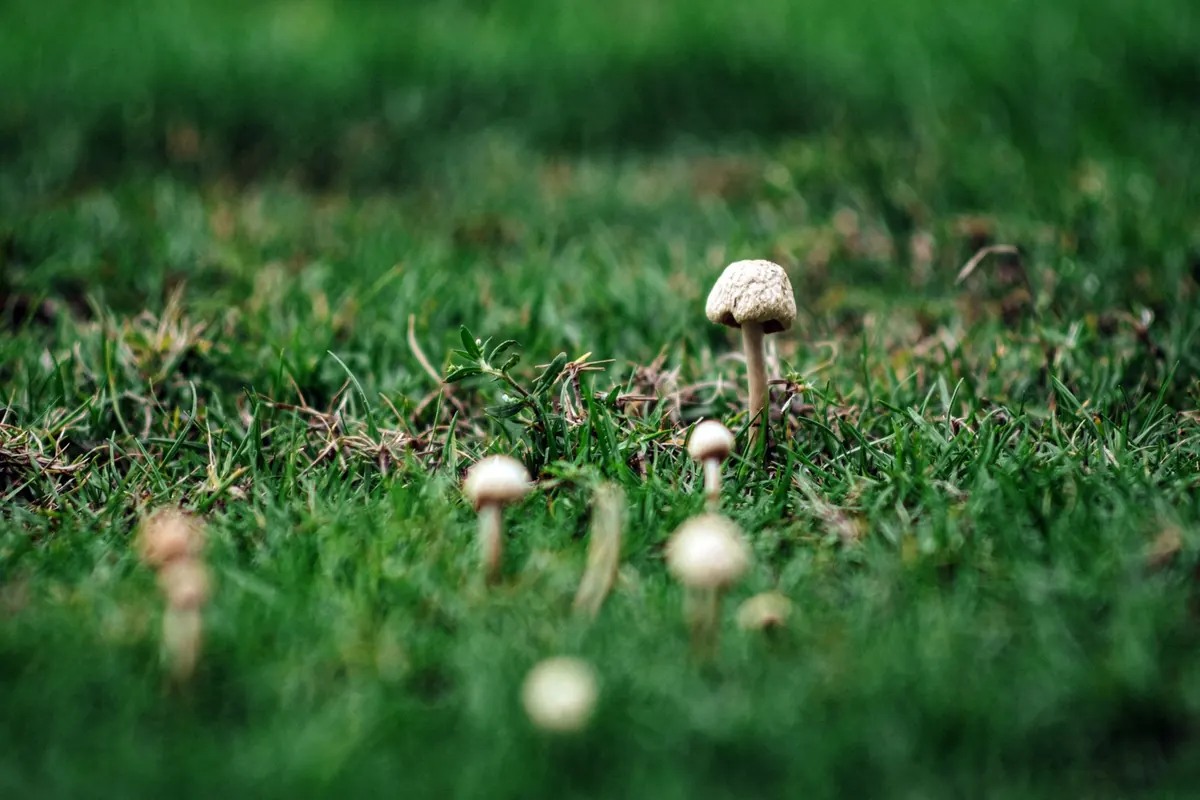
What you see is the fruit body of a fungus whose real body — a network of fine threads called mycelium — is spread through the soil, thatch or leaf litter. Fungi feed by growing into fresh material and breaking it down.
A fairy ring appears when a fungus starts from a single point and spreads outward at a roughly even rate in every direction. The middle is the oldest part. By the time the ring is big enough to notice, the mycelium there has used up much of what it can eat, so growth is strongest at the outer edge, and that is where mushrooms push up. The circle widens year by year — often by only a few centimetres, though the rate depends on the species, the soil and the weather. Rings several metres across in old pasture may be decades or centuries old.
Why the grass looks different: three rough types
- Type I. Turf inside the ring dies back, leaving bare or dark, greasy-looking ground. The mycelium has become dense enough to repel water and kill the grass directly.
- Type II. A band of darker, lusher grass, often with mushrooms in the same arc during autumn. As the fungus breaks down organic matter it releases nitrogen, which feeds the grass.
- Type III. Mushrooms or waxcaps in a ring with no obvious change to the grass. This is typical of old, unimproved pasture, and it is a sign of a habitat worth protecting.
Before you get close: safety and the law
- Never eat a mushroom found in a ring on the strength of a photograph or an app. The fairy ring champignon is genuinely edible and genuinely easy to confuse with fool's funnel, a white grassland species that grows in similar places and can cause serious poisoning. The difference lies in details of the gills, the cap and the smell.
- If someone may have eaten an unidentified mushroom, keep what is left, note where it was picked, and seek medical advice straight away — NHS 111 or a poisons service can advise.
- Take only what you can identify with certainty, and only where you have permission. Fungi on most land belong to the landowner. Picking for personal use is often tolerated but is not a right, and it is an offence to pick on a Site of Special Scientific Interest without consent.
- Mind the habitat. Waxcap grasslands are rare and recover slowly from trampling. Look from the edge, and don't rake, dig or strip turf.
Reading a ring on your walk
- Go looking in autumn, after rain, on short grass: lawns, verges, churchyards, old pasture. Rings often show best when the grass is wet with dew or lightly frosted.
- Stand back first and look for an arc rather than a full circle — most rings are broken or crescent-shaped.
- Note the basics: date, rough size in paces, the state of the grass, and where the mushrooms sit relative to the ring.
- Photograph it with something for scale, from above and from the side, without pulling anything up.
- Send the record to your county fungus recorder or local wildlife trust. Old grassland is under-recorded, and a single good record can carry weight.
What to do if you find one
Leave it alone. Don't dig it out, don't try to cure it, and don't eat from it. On a lawn, digging rarely removes the fungus and it usually returns; feeding and watering the grass masks the worst of a type I ring, and mowing straight through does no harm. The ring isn't ruining your lawn beyond the circle itself. In a field or an old churchyard, take a photograph and tell a local wildlife trust — that record may be more valuable than you'd expect.
Then step back and look at the shape. The best explanation anyone has for it is also the strangest: a single organism eating its way outward from one point, patiently, for longer than the house beside it has been standing.
Photo: Lê Đức Khánh / Pexels